
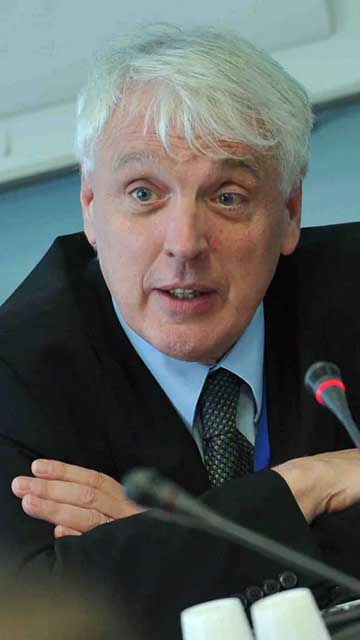
TRANSCRIPT:
It’s a great tool of public diplomacy, which costs a fraction of 1% of the $900 billion that the United States this year is planning to spend on the military, via the Pentagon budget and the defense authorization asset. So, it produces a massively big win for a comparatively small investment, particularly in building support and trust and confidence in the United States.
Why is it important? Well, because we live in a world in which, unlike 30 years ago, the adversaries of the United States — Russia, China, Iran, North Korea, many others — who even if they trade with the United States, even if they talk to the United States, these countries are not the friends of the United States, particularly not in the realm of values and ideology. And therefore, these countries are vastly stepping up, their public broadcasting efforts. Think of China Global TV, think of RT or Sputnik — the Russian networks trying to take away this audience — away from the United States with their own narrative about world affairs, which, believe me, is inimical to American values and foreign policy interests.
And the United States does not have to let this happen because it has very powerful tools of its own, of which Voice of America is one, Radio Free Europe, Radio Liberty, Al Hurra TV, there are many of these things. The United States has the tools, but to underinvest in them and just get rid of them at the present time simply leaves the field wide open for America’s adversaries to communicate with the kind of people who otherwise would be receptive to American foreign policy objectives. So, all Americans, I think, want to live in a safe, stable world where their values are shared beyond their borders, where the United States is seen as a trusted partner, and public broadcasting is a key part of that effort.
Published
Shea is a former senior NATO official who served as NATO spokesperson during the Kosovo conflict. He later held senior policy roles at NATO and became a prominent analyst on European security and transatlantic affairs.