
 Thailand
VOA shaped US-Thai relations, China and Russia now fill the void

A view from a VOA studio while the Thai Service conducts a live report on the 2024 U.S. presidential election.
Published
Among one of the first units at Voice of America, VOA’s Thai Service had brought news to Thailand for more than 75 years, broadcasting in the country’s primary language. At the start of 2025, it was reaching 4.1 million people in Thailand each week — or 7.3% of the country’s adults — and broadcasting 7.2 hours of audio and video reports every week. However, since President Donald Trump issued his March 14, 2025, executive order that effectively began dismantling VOA, the service has gone dark. It has stopped all broadcasts and is producing no content on digital media.
Before it was silenced, VOA’s Thai Service had developed more than 50 partnerships with media across the country. Those included national TV broadcasters MCOT and NBT, which weekly used VOA content, as well as MCOT’s podcast-style show “Good Morning ASEAN” on FM radio. The affiliate partners also included more than 30 radio stations throughout Thailand — in large cities and smaller communities — as well as contributing to university-produced media in all regions of the country.
With only about eight journalists in Washington in recent years and four stringers in other locations, the service had amassed a significant audience inside Thailand as well as reaching Thai-speakers across Asia. Its audience spanned policy-makers — including Chuan Leekpai, a former prime minister and House speaker, and Asa Sarasin, principal secretary to the late King Bhumibol Adulyadej — as well as a growing following among Thai youth and young professionals. In recent years, the service had expanded its social media presence to more than 800,000 followers, amassed more than 93 million total views on YouTube, and was gaining a wide following on YouTube’s Shorts platform and Instagram Reels. The service had recently launched a program to engage with thousands of Thai youths at universities across the country, leading seminars and lectures on the values of a democratic society, free press and ethics in journalism. From 2022 to 2024, VOA led a total of 17 events for university students.
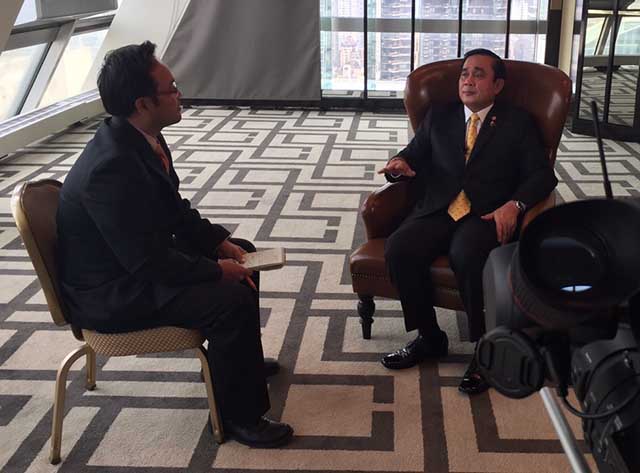 VOA Thai journalist Songphot Suphaphon interviews then Prime Minister Prayuth Chan-ocha on the sidelines of the 2015 UN General Assembly in New York. Prayuth led Thailand’s 2014 coup.
The service’s reporting regularly influenced Thai political developments. Investigative reporting by the Thai Service on transnational criminal activity uncovered networks with ties to Russia and China, and led to investigations by Thai lawmakers and law enforcement on a range of issues — from arms deals to scam centers operating near the country’s borders. Other impactful reporting included an exclusive feature by the Thai Service on the growing political engagement of Thai youth, which sparked widespread public discourse on pro-democratic reforms in the lead-up to national elections. The service’s reporting spanned countries, including comprehensive stories in early 2025 with VOA’s Mandarin Service on the fates of Uyghur detainees in Thailand, and reporting on a recent Thai-China submarine deal, with an English-language story on the topic receiving more than 40,000 views on VOAnews.com.
Media outlets across Thailand regularly relied on reports by VOA’s Thai Service for news about U.S. policies in a region where China and Russia are amping up their media operations. In 2023, a year after the start of the war in Ukraine, Thailand’s Channel 5 TV, which is controlled by the Thai military, began partnering with VOA’s Thai Service. As a result, the collaboration with VOA helped the station to balance its content, which had previously been influenced by Russian narratives. After VOA’s Thai Service stopped broadcasting in March 2025, Channel 5 TV’s international news team wrote, “We were absolutely delighted to consistently use VOA Thai’s content, which has diverse perspectives. We want to praise the VOA team for its professionalism, quality and long-lasting credibility.”
In the absence of VOA, Russia is again filling the void, along with China. After VOA stopped its broadcasts in mid-March 2025, MCOT — one of Thailand’s largest media companies — reassigned VOA Thai’s time slot to Chinese state media, a development reported on by the Wall Street Journal.
VOA Thai articles published online per week
Publishing on the VOA Thai website ceased following the president’s March 2025 executive order.
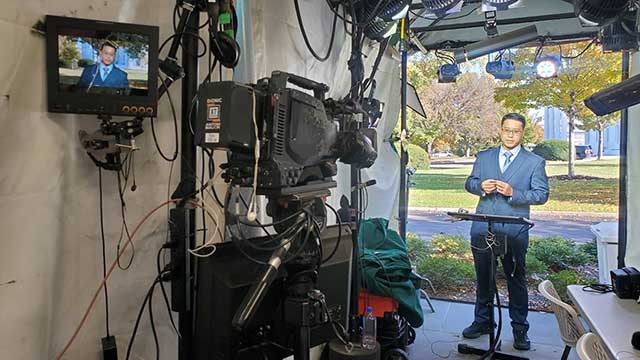
VOA Thai reporter Yiamyut Sutthichaya reports from the White House while covering the 2025 U.S. election. The service was regularly relied upon by its Thai media partners to cover major news stories in the United States.
Voices supporting VOA
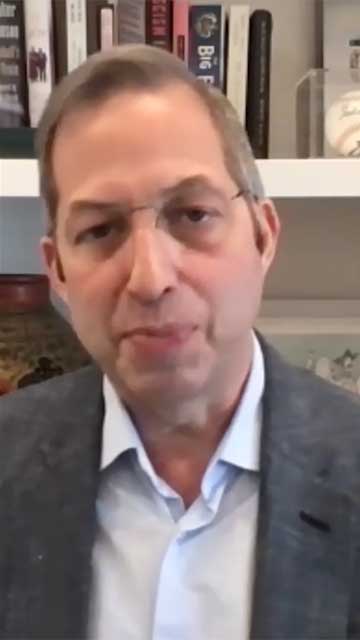
Derek Mitchell
Former U.S. ambassador to Myanmar
“The Chinese are filling the space that we are leaving … [if we] retreat from the battlefield others see that China is playing, it makes China look strong and America look weak. And I think it hurts us.”
Contact your representatives
If you are a U.S. citizen and believe there is value in Voice of America — particularly if you have a personal story about listening to or watching VOA — please reach out to your representatives in Congress to encourage them to allow VOA to continue its vital mission of delivering truth to the world. We've simplified the process by creating a page to help you find their contact information and by creating a sample script of what to say.
Find out more
Press freedom situation, according to Reporters Without Borders (RSF)
Source: 2025 RSF World Press Freedom Index
Missed opportunities
Major stories VOA was unable to cover because of the effort to shut it down.

At the time of the March 15, 2025, shutdown, VOA's Thai Service employed five full-time employees and two contractors.
Timeline of VOA’s Thai Service
1942 – 1945
WWII in the Pacific Theater
The Thai service debuts in 1942. Its reports during World War II focus on the Southeast Asia region and the Japanese military operations, which continue until 1945.
1954 – 1975
Vietnam War
After a pause from 1958-1962, the Thai Service is brought back on air as the Vietnam War escalates. Thailand is one of the United States’ strongest allies and VOA Thai covers the war from the perspective of this alliance.
LATE 1980s
VOA Thai partners with affiliates
VOA Thai expands its content distribution through affiliates across Thailand, reaching audiences in major cities and remote areas. This new growth model helps to inform a broader public about democratic principles in the runup to the country’s 1991 coup. The population takes to the streets in anti-military protests the following year, but the government violently cracks down on demonstrators.
November 1996
President Clinton visits Thailand
As Thailand seeks to restore its global image, decision-makers increasingly regard VOA Thai as an authoritative source for international perspectives. The service’s reputation is further elevated by its coverage of U.S. President Bill Clinton’s 1996 visit to Thailand.
September 11, 2001
9/11 and the hunt for the perpetrators
In the aftermath of the 9/11 attacks on the United States, the Thai Service is active in covering the U.S. operations to track down perpetrators who were hiding in Southeast Asia.
September 19, 2006
Thai PM ousted in coup
The coup that ousts Prime Minister Thaksin Shinawatra draws audiences to VOA Thai’s exclusive reporting from New York, where the prime minister was attending the UN General Assembly.
May 22, 2014
Second coup in less than a decade
When another military leader deposes Thaksin Shinawatra’s sister, Prime Minister Yingluck Shinawatra, VOA Thai provides live broadcasts from Washington capturing global reactions as domestic news outlets are shuttered by military order.
Post-2014 coup
Thailand moves closer to China
Over the decade following the coup, Thailand moves closer to China’s sphere of influence, marked by expanded trade, investment and military cooperation. VOA Thai closely examines these developments, reporting on issues such as weak environmental standards, unethical business practices and the risks of economic overreliance.
2019
VOA’s Thai audience soars
While press freedom in Thailand declines sharply from the time of the 2006 coup, VOA Thai’s audience grows dramatically, reaching 100 million Facebook views in 2019.
2020 pro-reform movement
Student-led protests demand accountability
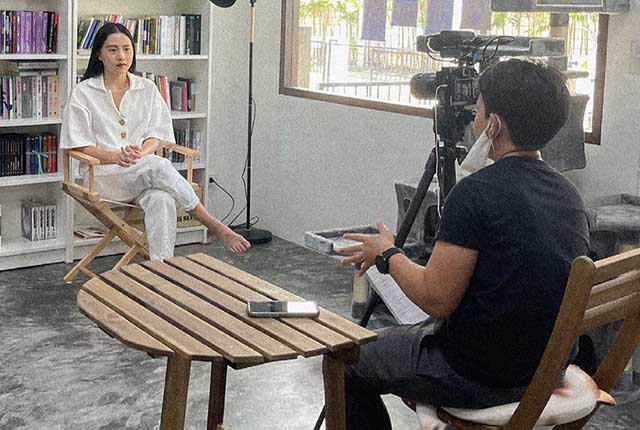
A groundswell of student-led protests demanding greater transparency and accountability from the long-revered monarchy mark a watershed moment. The government, led by a former coup leader, arrests numerous protesters on charges of royal defamation and sedition. As most local media avoid in-depth coverage, VOA Thai fills the gap with comprehensive reporting, including interviews with youth leaders such as Rukchanok Srinork (pictured above), who would go on to become a prominent member of parliament.
2020
Thai parliamentarian cites VOA report on junta leader
During a 2020 parliamentary session, Pannika Wanich, a member of the progressive Future Forward Party, cites a 2016 VOA Thai interview with Prime Minister Prayut Chan-o-cha, in which Prayut said he did not plan to run in elections. Wanich sought to hold Prayut, who led the 2014 military coup, to his word that he did not have political ambitions.
2021
Washington’s distribution of COVID vaccines
VOA’s Thai Service is at the forefront of covering the U.S. operations to distribute mRNA vaccines to developing countries during the COVID pandemic.
2021 – 2024
College outreach
After COVID restrictions are lifted, VOA Thai intensifies its on-site outreach to college students. Building on its award-winning documentaries, the service hosts screening events at universities across Thailand, showcasing human-centered stories that underscore the importance of democratic values.
March 15, 2025
After more than 75 years of service, VOA Thai programming goes dark
USAGM, led by Trump appointee Kari Lake, ceases all VOA programming, forbids journalists from reporting the news, and places more than 1,300 workers on administrative leave.
Voices of support
“The departure of Voice of America also leaves a gaping vacuum in the information world that can only be filled by countries like China and Russia. And believe me, [Russian President] Vladimir Putin and [Chinese President] Xi Jinping aren’t going to give the world a clear picture of what’s going on in their countries, much less in the United States.”

David Shear
Former U.S. ambassador to Vietnam
“When you silence the Voice of America, the rest of the world is going to get propaganda. And believe me, the Russians and the Chinese will be very happy to fill that gap.”

Christine Todd Whitman
Former Republican governor of New Jersey
“Voice of America is a much cheaper way for the United States to influence and inform people around the world — cheaper than sending our military, even cheaper than setting up U.S. embassies around the world.”

David Kramer
Former U.S. assistant secretary of state