
STATUS UPDATE: After being dark for 17 months, VOA’s Russian Service resumed operations in August 2026. The service’s output is down from its pre-March 2025 levels and its journalists are under pressure to be a mouthpiece for the administration.
 Russia
VOA helped to end the Cold War. It was still fighting Russian disinformation when it was silenced

VOA Russian reporter Natalka Pisnia interviews Rep. Jim Costa. VOA reporters regularly interview U.S. representatives to explain U.S. news and changes in government policies to a Russian-speaking audience.
Published
Since President Donald Trump issued his March 14, 2025, executive order to begin dismantling Voice of America, its Russian-language broadcasts have gone dark.
Before Trump’s order, VOA’s Russian Service was producing 13.5 hours of audio and video reports each week, regularly reaching 4.8 million people in Russia, or 4% of the adult population, despite tight government restrictions against independent media. It was also delivering news to Russian-speaking populations throughout Eurasia and around the world. Now, it has stopped all broadcasts and is producing no content on digital media.
VOA’s unbiased, fact-based reporting is widely credited with helping to end the Cold War. “Among the forces that tore holes in the Iron Curtain was the steady bombardment by the Voice of America [and] Radio Free Europe and Radio Liberty,” said Strobe Talbott, who served as President Bill Clinton’s deputy secretary of state.
Since Russian President Vladimir Putin’s consolidation of power, along with his full-scale invasion of Ukraine, VOA was again at the forefront of spreading truth throughout Eastern Europe and routinely piercing the Kremlin’s “digital Iron Curtain.”
Trump’s mid-March 2025 executive order, which largely silenced the international broadcaster, has been met with criticism. “Many of the American and foreign reporters who have squared off against the world’s most brutal dictatorships for VOA and other U.S.-funded outlets every day have performed heroically,” wrote the senior editorial staff of the National Review magazine on March 20, 2025. “Unlike the propagandists who work for Beijing or Moscow, employees of Voice of America and USAGM grantees are real journalists who do real reporting, often at great risk to themselves and their families,” they said.
The VOA Russian Service provided around-the-clock, live-streamed coverage of historic events, including live-streamed Russian language coverage of historic events, including Trump’s acceptance speech on Election Night 2024, garnered millions of views on YouTube; Trump’s February Oval Office meeting with Ukrainian President Volodymyr Zelenskyy was also viewed by millions. Seconds after Russia released high-profile political prisoners — including Wall Street Journal reporter Evan Gershkovich, opposition leader Vladimir Kara-Murza and Radio Free Europe/Radio Liberty journalist Alsu Kurmasheva — VOA’s Ksenia Turkova and Roman Mamonov hosted marathon Russian-language streaming coverage that featured guest interviews and insights by prominent American officials and experts alongside footage of the prisoners’ arrivals in Germany.
The high-quality, fact-based reporting by VOA’s Russian Service is emblematic of the agency’s broader mission to battle authoritarianism and deliver truthful information in 49 languages daily. Russian media officials cheered the news of VOA’s silencing, underscoring how repressive governments view the efforts to stop VOA’s broadcasts as a win.
In its effort to disseminate credible news, VOA’s Russian Service has in recent years significantly expanded its digital footprint — launching websites, mobile apps, podcast platforms and social media channels. It has also improved the use of circumvention tools to ensure its audience has access to VOA’s journalism despite Russia’s increased censorship.
Moscow has spent decades growing its government-controlled media empire. Funding for Kremlin-financed, and Kremlin-directed propaganda, which is just one part of Russia’s global disinformation campaigns, is slated to grow further in 2026, according to preliminary budget figures. Some estimates put funding at record highs.
VOA Russian articles published online per week
Publishing on the VOA Russian website ceased following the president’s March 2025 executive order.
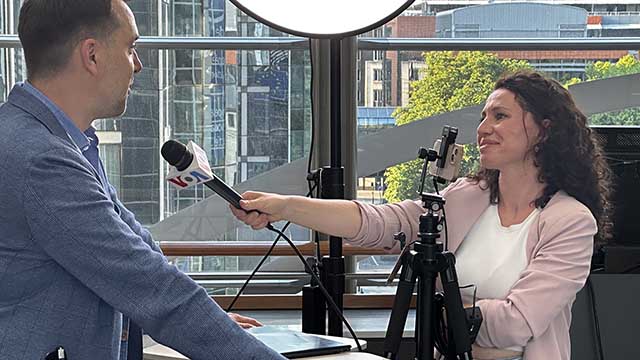
VOA Russian reporter Valentina Vasileva interviews Oleksii Arestovych, adviser to the Office of the President of Ukraine. Reporters with VOA's Russian Service regularly seek out policymakers and analysts to provide context to the war in Ukraine beyond Kremlin control.
Voices from VOA
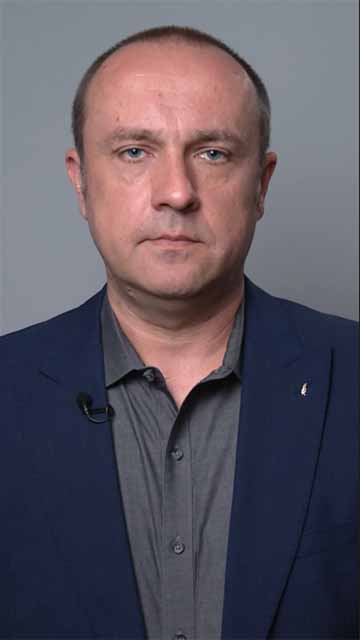
Alexander Yanevskyy
VOA reporter
“When VOA was taken off the air, press freedom and freedom of speech died a little, too. And when these freedoms are gone, disinformation will gladly take their place.”
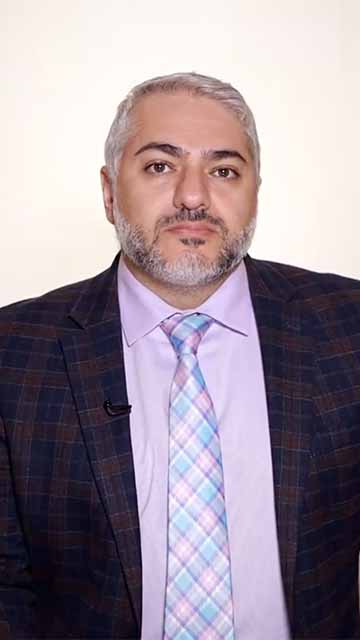
Rafael Saakov
VOA Russian reporter
“From exposing political prisoners in Russia to covering U.S. lawmakers fighting for human rights, VOA's Russian Service told stories that President Vladimir Putin did not want the Russian-speaking audience to hear.”

Yulia Savchenko
VOA Journalist
“In a world clouded by competing narratives and misinformation, silencing the Voice of America surrenders the battlefield of truth.”
Voices supporting VOA
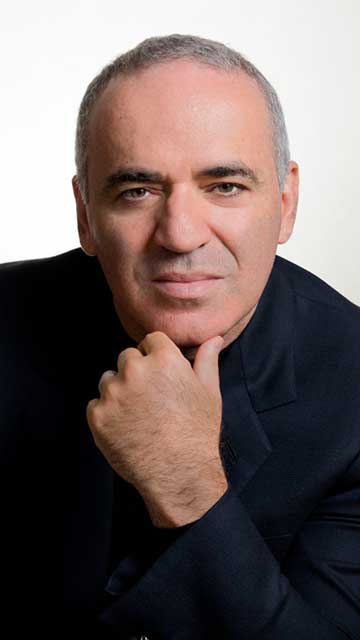
Garry Kasparov
Russian chess grandmaster and human rights activist
“I think a lot of people in this country [the U.S.] or in the free world at large, they simply may not understand the value of Voice of America or Radio Liberty. Not me. I mean, I grew up in the Soviet Union with millions and millions of others on the other side of the Iron Curtain.”
Adversarial voices
“Today is a holiday for me and my colleagues at RT and Sputnik. … We couldn’t shut them down, unfortunately, but America did so itself.”
— Margarita Simonyan
Editor-in-chief of the Kremlin-directed RT network and the Rossiya Segodnya news agency speaking about the closure of VOA and Radio Free Europe / Radio Liberty
Contact your representatives
If you are a U.S. citizen and believe there is value in Voice of America — particularly if you have a personal story about listening to or watching VOA — please reach out to your representatives in Congress to encourage them to allow VOA to continue its vital mission of delivering truth to the world. We've simplified the process by creating a page to help you find their contact information and by creating a sample script of what to say.
Find out more
Press freedom situation, according to Reporters Without Borders (RSF)
Source: 2025 RSF World Press Freedom Index
Missed opportunities
Major stories VOA was unable to cover because of the effort to shut it down.
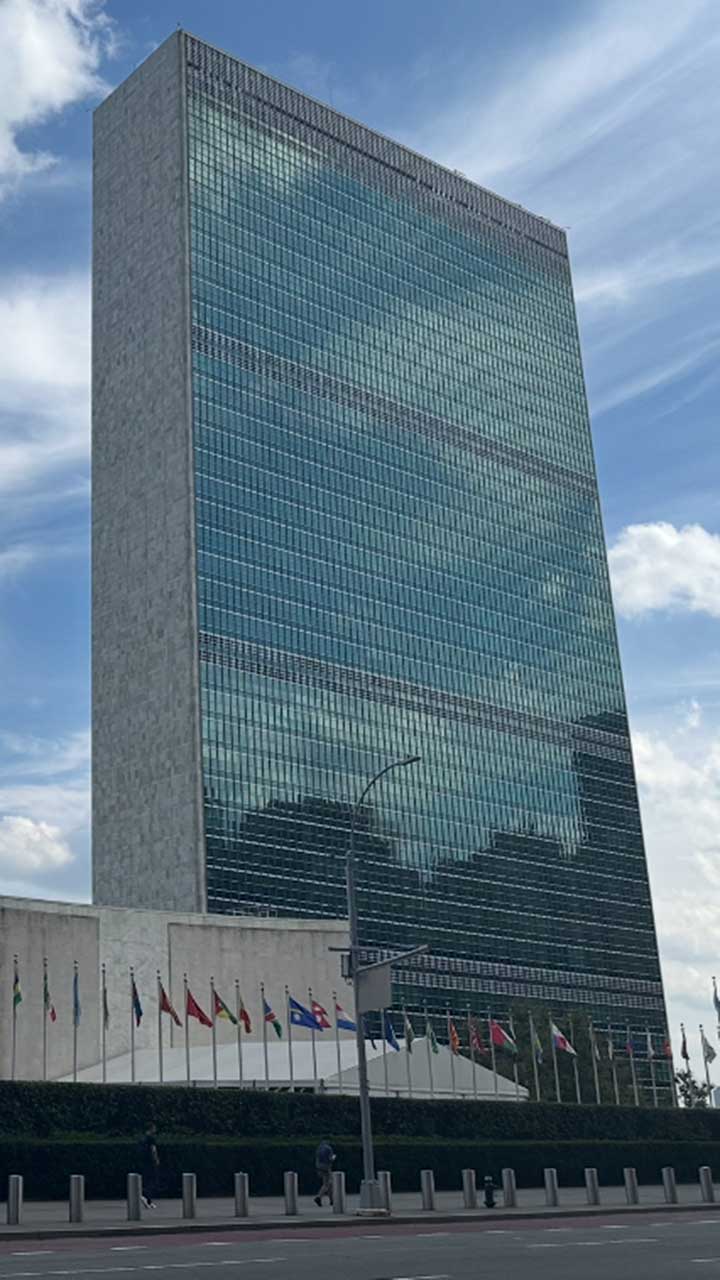
Silenced at UNGA: VOA shrinks, Moscow expands
Headlines on how Russia and China are filling the void left by VOA
- The Kremlin’s expanding media conglomerate 2026 (The Institute for the Study of War) “The Kremlin and other US adversaries, such as the PRC, will likely try to compete for and fill the spaces in the information spaces in Africa, Asia, and Latin America, which the United States left vacant as it reduced the media footprint of the Voice of America and US Agency for Global Media (USAGM). Maintaining a global US media outreach effort is essential to deny US adversaries the ability to advance their objectives via cognitive warfare means.”
- The US retreat from international broadcasting is a gift to Russia’s disinformation efforts (Harriman Magazine)
- Why the U.S. is losing the battle for hearts and minds (The Washington Post) As rivals flood the world with propaganda, Washington is dismantling its best tools to respond.
- America surrenders in the global information wars (The Atlantic) The U.S. is reorienting its foreign policy to protect governments that manipulate and suppress information.
- Kari Lake’s accusations about VOA and China are bad for the country (The Washington Post) Kari Lake says VOA cooperated with the Chinese Communist Party. In reality, VOA fights propaganda.
- Show all headlines
- As U.S. dismantles Voice of America, rival powers hope to fill the void (The New York Times) The Trump administration is not just releasing its grip on the global megaphone but handing it off to its eager adversaries, foreign policy experts say.
- RT on the rise as VOA fades (The World)
- China and Russia rejoice as the US cuts its global media (Foundation for Defense of Democracies)
- As Trump silences Voice of America, Russia and China seize the opportunity to reshape Africa’s news ecosystem (NiemanLab)
- Trump mutes Voice of America, makes space for Russian and Chinese influence (France 24)
- Russian TV celebrates Trump's 'awesome' move to shut down Voice of America (Newsweek)
- Stalin, Mao and Khomeini couldn’t quell freedom’s voice. But Trump did (The Washington Post) The world’s autocrats are doing somersaults about the silencing of the Voice of America.

At the time of the March 15, 2025, shutdown, VOA's Russian Service employed 25 full-time employees, 41 contractors and a network of stringers.
Timeline of VOA’s Russian Service
February 17, 1947
VOA begins broadcasting in Russian
VOA debuts its first Russian-language broadcasts from New York City, marking the start of the Cold War-era broadcasts and the beginning of counter-Soviet propaganda efforts.
1949 – 1990s
Soviet Union attempts to block VOA broadcasts
The Kremlin jams VOA broadcasts that provide an alternative view of events inside and outside the Soviet Union. During the Cold War, VOA’s Russian Service broadcasts the voices of important Russian dissidents such as Aleksandr Solzhenitsyn.
February 24, 1982
Reagan refers to VOA as “the ultimate weapon”
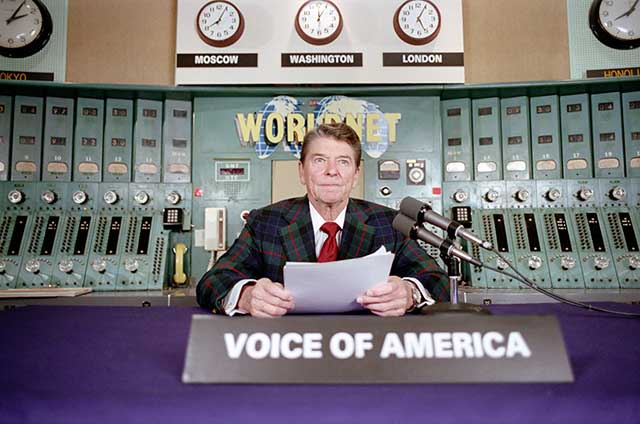
Throughout his two terms in the Oval Office, President Ronald Reagan saw VOA’s Russian Service as crucial to effective communication with the Soviet people, providing them with uncensored information and fostering democratic values. He consistently advocated for strengthening and modernizing international broadcasting efforts to counter Soviet propaganda. In a 1982 speech, Reagan referred to VOA as “the ultimate weapon in the arsenal of democracy,” with its broadcasts of objective news working to undermine the totalitarian Soviet system.
August 1991
President Gorbachev turns to VOA for news
During the 1991 August attempted coup, Soviet President Mikhail Gorbachev famously listened to foreign radio stations, including VOA, to learn what was happening in the outside world. While he was held incommunicado at his vacation villa in Crimea, he and his loyal guards secretly received news about the coup plotters’ defeat by rigging up old shortwave radios.
1990s
VOA Russian covers the fall of the Soviet Union
The service comprehensively covers the collapse of the Soviet Union, the newfound independence of former Soviet states, and the eventual rise of Vladimir Putin.
August 2008
Russia invades Georgia
VOA Russian provides comprehensive coverage of the invasion and the breakdown of diplomatic relations between Georgia and Russia that results. In the following years, the service provides fact-based reporting on Georgia’s political alignment with Russia versus the West, Georgia’s role in sanctions evasion and domestic political divisions.
Early 2014
Russia annexes Crimea
VOA’s Russian Service launches Current Time in October 2014, a joint news program with Radio Free Europe / Radio Liberty to cover the aftermath of annexation of Crimea and the start of subsequent fighting in eastern Ukraine. In 2016, the service launches its daily news program Current Time America.
February 24, 2022
Russia invades Ukraine
VOA Russian provides daily, thorough, multi-platform coverage of Russia’s invasion of Ukraine until it is forced to stop broadcasting.
March 15, 2025
After 78 years of service, VOA Russian programming goes dark
USAGM, led by Trump appointee Kari Lake, ceases all VOA programming, forbids journalists from reporting the news, and places more than 1,300 workers on administrative leave.
Voices of support
“VOA’s Russian service is one of the few platforms for real free substantive debate that we can have among ourselves as members of Russian civil society. … I know that many, many people inside Russia either listen to these programs or watch them or read them, and the programs have a big reach and a big impact, one that is frankly irreplaceable.”

Vladimir Kara-Murza
Russian journalist and opposition politician
“[VOA] has credibility in those circles in Russia, in the former Soviet Union, that you don’t buy overnight. It built it up over the years. Nobody else has the same credibility. I mean BBC, Deutsche Welle, these other services just don’t carry that je ne sais quoi, that certain credibility that VOA carried.”

Michael David Kirby
Former U.S. ambassador to Moldova and Serbia
“When we pull the plug on one of our instruments to reach the world, our adversaries will take heart and be encouraged.”

Daniel Fried
Former U.S. ambassador to Poland
“Voice of America is more important now perhaps than any time since the Cold War. At this time, Russia is committing armed aggression against Ukraine. It’s more repressive now than it has been at any time since the Soviet Union existed. It is vital that people all over the world, and certainly in the region, understand what’s happening.”

William Courtney
Former U.S. ambassador to Kazakhstan, Georgia and the U.S.-Soviet Test Ban Commission
“Voice of America is the best way to counter the bad information that is coming out of Russia. We see it most directly and most clearly and most blatantly in their war, the Russian war against Ukraine. … The best way to counter the falsehoods, the misinformation and disinformation that is coming out of the Kremlin … is by sending truth to the world.”

William Taylor
Former U.S. ambassador to Ukraine