
STATUS UPDATE: After being dark for nine months, VOA’s Korean Service resumed operations in December 2025. While many of its broadcasts are back on the air, not all are, and its journalists are under pressure to be a mouthpiece for the administration.
 North Korea
Renewed VOA broadcasts to North Korea pale in comparison to former coverage

VOA Korean reporter Sungwon Baik covers a large-scale military parade in Pyongyang marking the first public display of intercontinental ballistic missiles believed capable of striking the U.S. mainland.
Updated
For more than 80 years, Voice of America has broadcast in Korean. First, providing reliable news and information to Koreans living under Japanese occupation during World War II, then offering that same lifeline to populations facing the struggles of post-war division, the Korean War and the North’s long rule by a dynasty of dictators. As the North Korean government cracked down on outside information, VOA focused on reaching influential elites, who represent 10-15% of the population.
When 2025 started, VOA’s Korean Service was broadcasting 51.9 hours of audio and video reports in Korean each week, providing news not available on state-controlled media. After President Donald Trump issued his March 14, 2025, executive order that effectively began dismantling VOA, the service went dark for nine months.
In December 2025, a handful of former VOA contractors were rehired to resume minimal broadcasts in Korean. As of September 2026, it was airing around-the-clock coverage on weekdays, but only 35 of those hours were new content. Additionally, the renewed programming is largely ineffective because it ignores two key issues facing North Korea. First, the 24-hour weekday broadcasting does not make sense strategically because between 8 a.m. and 8 p.m. it would be extremely difficult for anyone to tune in to VOA due to government restrictions. Second, the broadcasts during critical overnight hours when people can listen are on just two shortwave frequencies, which makes them easy for the government to jam.
Plug pulled on TV breakthrough
Before the Korean Service was significantly curtailed, it had been making huge strides in increasing its reach inside North Korea. After a decade of negotiations between the U.S. and South Korean governments, VOA was granted access in early 2023 to South Korean state-controlled broadcast towers along the inter-Korean border. The result was historic. People living in one of the most tightly controlled countries in the world were able to watch a 25-minute TV program that provided accurate, uncensored news and information. That is, until it was stopped.
The show, the Korean Service’s flagship program “Washington Talk,” aired four times a week on TV and online, and gave audiences unbiased explanations and analysis of U.S. foreign policy including U.S. views on North Korea’s weapons development, its dealings with China and Russia, North Korean sanctions violations and other political issues within Korea. In addition to the uncensored reporting, “Washington Talk” provided audiences with the unique opportunity to hear directly from White House, State Department, Pentagon and CIA officials as well as leading Washington experts.
The show drew up to 550,000 online viewers per episode and earned recognition in Seoul and Washington as the premier forum explaining America’s Korea strategy in the Korean language. It was making a real impact inside of North Korea before it was shut down.
Reputation of critical reporting
VOA’s Korean Service was also known for carrying out groundbreaking reporting on topics that included North Korea’s sanctions-evasion schemes, the use of North Korean weapons in the October 7, 2023, Hamas attack on Israel, and the mistreatment of Otto Warmbier, an American university student who died shortly after his release from more than a year in North Korean custody. Its reporting on weapons distribution, based on careful examination of satellite imagery, exposed ship-to-ship smuggling networks and drove U.N. and U.S. policy discussions on the issue.
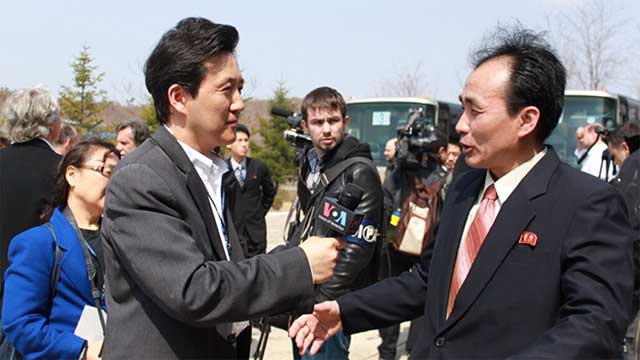 VOA reporter Sungwon Baik questions a North Korean official during a rare media tour of Pyongyang’s Satellite Control Center.
VOA was on the ground in April 2012 when Pyongyang staged what it called a “peaceful satellite launch.” Among the foreign press covering the event, only VOA’s Korean correspondent could understand the language around him. It was an advantage that proved pivotal. While documenting remarks delivered to a small group, a North Korean professor who doubled as a semi-official spokesperson let slip that the same technology used for the launch could also serve military purposes. It was the first time a North Korean insider had publicly acknowledged this link, and VOA’s reporting captured it in real time.
Without VOA’s critical reporting, the world faces a deeper information black hole around North Korea’s human rights situation. VOA’s Korean Service had long made human rights one of its core reporting priorities, closely following U.S. and U.N. actions, international sanctions and humanitarian aid initiatives linked to North Korea’s rights conditions. It has also documented the government’s overseas labor programs, which sends workers abroad to earn hard currency. To cover the story, the Korean Service had journalists report from North Korea as well as Qatar, Senegal and Russia. After a 2014 U.N. report detailed gross human rights violations by Pyongyang, the Korean Service conducted a one-on-one interview with Jang Il-hun, North Korea’s deputy ambassador to the U.N., directly challenging him on the government’s human-rights record — a rare moment of accountability.
Audience of influential elites
Because of the government’s near total control of the media, audience research is impossible within North Korea. However, VOA’s parent organization, the U.S. Agency for Global Media, was able to survey individuals who had left the country. Defectors and refugees have repeatedly confirmed that they listened to VOA and its sister network Radio Free Asia from inside North Korea despite government threats of harsh penalties.
A high-ranking North Korean defector, Thae Young-ho, the country’s former deputy ambassador to the North Korean embassy in Britain, told VOA in 2016 that the North Korean regime “pays great attention [to] the contents of VOA.”
With VOA’s Korean Service significantly curtailed, North Korean elites, diplomats and others have been left without an objective, accurate and comprehensive news source in Korean. Many have had to turn to state media and second-hand narratives, which are often shaped by hostile or incomplete reports and pro-China messaging. South Koreans who relied on the service are also left without a source of U.S.-based news and must rely almost entirely on domestic media, whose coverage of U.S. positions is often politicized or influenced by anti-U.S. narratives.
VOA Korean articles published online per week
Publishing on the VOA Korean website ceased following the president’s March 2025 executive order.
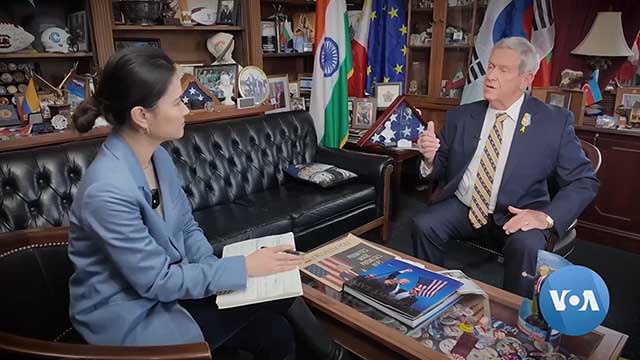
VOA reporter Joeun Lee interviews Rep. Joe Wilson. Reporters with VOA’s Korean Service regularly interview U.S. members of Congress. The service is responsible for bringing news about the United States and the country's policies to its Korean-speaking audience.
Voices supporting VOA

Ret. Col. David Maxwell
U.S. Army Special Forces
“Every member of the North Korean diaspora, or escapees, speak of the importance of the information they received from Voice of America and how it shaped their desire to be free.”
Renewed broadcasts in Korean are performative, not strategic
For decades, VOA’s broadcasting to North Korea was designed to penetrate one of the most restrictive media markets in the world. Years of USAGM-funded research conducted with North Korean defectors, refugees and travelers has shown that U.S. media can only reach North Koreans under very specific conditions. VOA’s recently expanded broadcasts to the country do not meet North Koreans’ unique needs.
Because North Koreans can be imprisoned, tortured or even executed for consuming foreign media, those who take enormous risks to get outside information say the safest time to do so is during the middle of the night. For this reason, before VOA was largely silenced in March 2025, it focused all its broadcasts to North Korea during the nighttime hours. Broadcasts from VOA’s Korean Service, along with VOA’s sister outlet, Radio Free Asia, had covered all overnight hours in North Korea. Conversely, VOA is now broadcasting around the clock on weekdays into North Korea, much of it repeated content and most of it impossible to listen to.
Even more critically, the current output is broadcast on only two shortwave radio frequencies during the crucial nighttime hours. This makes it vulnerable to jamming by the North Korean and Chinese governments. Before VOA was largely dismantled, it worked to counter government jamming as well as to overcome the normal impediments of cross-border radio signals — such as atmospheric conditions and physical obstructions like large buildings — by broadcasting on an array of frequencies. It found that using multiple shortwave frequencies overnight as well as two high-powered medium wave (AM) transmissions from South Korea was necessary to ensure people could listen to VOA’s broadcasts.
Contact your representatives
If you are a U.S. citizen and believe there is value in Voice of America — particularly if you have a personal story about listening to or watching VOA — please reach out to your representatives in Congress to encourage them to allow VOA to continue its vital mission of delivering truth to the world. We've simplified the process by creating a page to help you find their contact information and by creating a sample script of what to say.
Find out more
Press freedom situation, according to Reporters Without Borders (RSF)
Source: 2025 RSF World Press Freedom Index
Missed opportunities
Major stories VOA was unable to cover because of the effort to shut it down.
Headlines on the loss of VOA to North Korea
- Trump’s cuts to Voice of America imperil radio broadcasts into North Korea (NK News)
- We must restore the US Agency for Global Media, not eliminate it (National Review)
- RFA and VOA shutdown: The erosion of US soft power in Southeast Asia (CSIS)
- North and South Korea are in an underground war — Kim Jong Un might now be winning (BBC)
- A secret program allowed VOA to broadcast television into North Korea. Now it’s gone. (Columbia Journalism Review)
- Show all headlines
- Silencing radio broadcasts – no good news for North Korea (Patheos)
- North Koreans left in the dark as foreign broadcasts cut (DW)
- The signal that crosses borders: Voice of America and Radio Free Asia (UPI)
- Voice, truth and the Korean Peninsula (UPI)

At the time of the March 15, 2025, shutdown, VOA's Korean Service employed 22 full-time employees and 16 contractors. On December 15, 2025, a fraction of those journalists were recalled to produce a minimal amount of content.
Timeline of VOA’s Korean Service
August 29, 1942
Korean Service launches with “Bell of Freedom” broadcast
VOA begins dedicated Korean-language programming during World War II to reach listeners under Japanese occupation. Broadcasting from San Francisco, VOA’s Korean Service brings messages of hope and liberation across Asia.
August 15, 1945
VOA reports Japan’s surrender in Korean
Koreans hear trusted information about Japan’s surrender through VOA broadcasts before domestic media is able to report the news.
June 25, 1950 – July 27, 1953
Korean War coverage
During the outbreak of the Korean War, VOA Korean delivers breaking reports on the conflict, relaying the U.S. decision to intervene under the United Nations Command and sharing accurate battlefield updates and allied statements to Korean audiences under crisis.
October 21, 1994
US–North Korea Agreed Framework
Amid the first North Korean nuclear crisis, VOA Korean reports on the signing of the Agreed Framework, explaining its aim to freeze Pyongyang’s nuclear program in exchange for light-water reactors. The coverage helps audiences understand the accord’s main terms and international response.
October 9, 2006
North Korea’s first nuclear test
VOA Korean delivers continuous coverage of Pyongyang’s first nuclear detonation, reporting on U.S. and U.N. responses and providing Korean audiences with clear, factual explanations of the resulting international sanctions and diplomatic actions.
September 2011
Only US media reporting from Pyongyang
VOA Korean gains access to North Korea and delivers firsthand reports on political and diplomatic events — the sole U.S. outlet allowed in the country at the time. The trip came about after a Korean Service reporter met with a North Korean diplomat during the North Korean Taekwondo team’s visit to the United States, and persistently followed up with months of outreach to North Korean officials.
April 2012
On-site reporting during North Korean long-range rocket launch
VOA Korean reports on the launch from Pyongyang of what the government describes as a “peaceful satellite launch.” VOA reports that the launch is a test of long-range ballistic missile technology and is able to capture a rare North Korean insider admission of this fact. VOA’s Korean correspondent is the only Korean-speaking reporter among all the foreign journalists covering the event, enabling the service to uncover critical truths behind the official narrative.
February 2014
U.N. Commission of Inquiry on human rights
VOA Korean reports on the U.N. Commission’s landmark findings of North Korea’s systematic abuses and crimes against humanity. The service explains the global response and how the U.S. government supports those efforts through sanctions and diplomacy.
2018 – 2019
US–North Korean summits
Dispatching correspondents and camera crews to Singapore (2018), Hanoi (2019), and Panmunjom (2019), VOA’s Korean Service covers the unprecedented meetings between President Trump and Chairman Kim Jong Un. As the only U.S. outlet delivering live Korean-language coverage across radio, TV and digital platforms, VOA Korean provides real-time updates, contextual analysis of the diplomatic stakes, and exclusive on-site footage. The coverage allows Korean audiences — including policymakers in Seoul and Pyongyang — to follow the developments at the summit without political spin, capturing both breakthroughs and breakdowns in nuclear diplomacy as they unfold.
2019 – 2024
Exposing DPRK sanctions-evasion networks
VOA Korean uses satellite imagery and investigative reporting to uncover DPRK ship-to-ship transfers and the illicit procurement of weapons. The reporting shapes U.N. and U.S. policy discussions on the issue. The service also reports exclusively on North Korean construction laborers working illegally in Senegal in 2019, and a 2021 exposé revealing blueprints for a North Korean-built monument project in Benin.
December 2023 – January 2024
Uncovering DPRK weapons in the Israel–Gaza conflict
The service reveals evidence that weapons and components of weapons made in North Korea were used in the October 7 Hamas attack on Israel, highlighting the threat of Pyongyang’s global proliferation of weapons.
March 15, 2025
After 83 years of service, VOA Korean programming goes dark
USAGM, led by Kari Lake, ceases all VOA programming, forbids journalists from reporting the news, and places more than 1,300 workers on administrative leave.
December 15, 2025
Handful of workers return
USAGM rehires a handful of former VOA contractors to resume limited operations of the Korean Service.
Voices of support
“North Koreans are denied access to information. … They are not allowed by law and they are imprisoned if they do listen to foreign radio broadcasts. But people are willing to take the risk and do it because they want to know what’s going on.”

Robert King
Former U.S. envoy for North Korean human rights
“Voice of America is a much cheaper way for the United States to influence and inform people around the world — cheaper than sending our military, even cheaper than setting up U.S. embassies around the world.”

David Kramer
Former U.S. assistant secretary of state