Kurdish region
With VOA silenced, Kurdish region loses a key source of independent news

VOA Kurdish journalists Balen Saleh and Herow Rahim record “View from Washington,” a TV show about U.S. politics. VOA journalists were placed on administrative leave on March 15, 2025. Show host Saleh (left), who died of a heart attack at age 63 on March 30, 2025, had a deep commitment to VOA’s mission, his coworkers said.
Updated
For more than three decades, Voice of America’s Kurdish Service provided news to millions of Kurds around the world, primarily in Iraq, Syria, Turkey and Iran, but also in Europe and North America.
In addition to presenting the news, the service embodied America’s belief that truth, when spoken freely, is stronger than propaganda or fear. It gave people in remote parts of the region an understanding — sometimes for the first time — that there is a world where honest information is not a crime.
At the start of 2025, the Kurdish Service was broadcasting 68.1 hours of audio and video reports each week in two Kurdish dialects: Sorani and Kurmanji. But after President Donald Trump issued an executive order on March 14, 2025, that effectively began dismantling VOA, the service went dark for 10 months. In January, a handful of VOA employees were brought back to produce limited content in Kurdish. With few resources available and VOA’s international reporting almost entirely silenced, the Kurdish Service is a shell of its former self.
Before March 2025, the service reached several million people each week, helping its audience to understand world events, democratic values and U.S. policy through accurate and independent journalism. It regularly brought news to its Kurdish-speaking audience about the U.S. military’s involvement in Iraq and Syria as well as U.S. support for Kurdish forces in the region fighting ISIS.
The service reached communities that have long been marginalized and amplified voices that are rarely heard. It was one of the few truly independent sources of news in the Kurdish language.
In its purest form, VOA’s Kurdish Service was a showcase of democracy in a part of the world that often aspires to it. A free press can lead to policy changes that benefit the people. And the Kurdish Service made that happen. Here are two examples:
• A VOA radio show that focused on workers’ rights and workplace safety led to the Ministry of Labor and Social Affairs in the Kurdistan Region of Iraq creating new policy directives to improve safety and health monitors for workers.
• A VOA TV report played a decisive role in preventing the destruction of approximately 150,000 fruit trees in the Garmian area of the Kurdistan Region of Iraq and the loss of livelihoods of local farmers.
With VOA’s Kurdish Service largely silenced, the information space has been dominated by state-controlled or politically-affiliated media outlets. Some are linked to regional governments and factions within the Kurdistan Region of Iraq, others are foreign state broadcasters such as Iran’s Sahar TV and Turkey’s TRT Kurdi.
These outlets either promote government viewpoints or avoid sensitive political topics. As a result, large parts of the Kurdish-speaking population, particularly those in rural or conflict-affected areas, are now stuck in an environment where independent and verified information is scarce, and propaganda and misinformation fill the void.
VOA Kurdish articles published online per week
Publishing on VOA Kurdish websites ceased following the president’s March 2025 executive order.
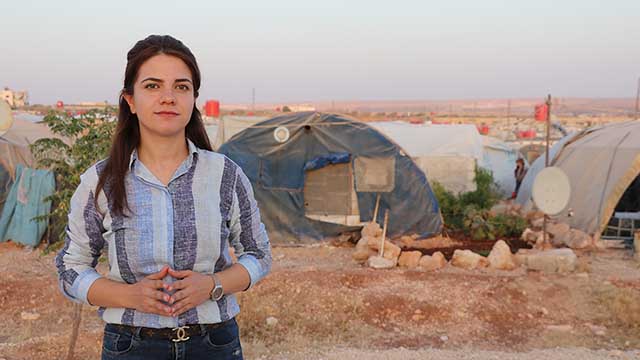
Newroz Rasho reporting for VOA in the Shahba refugee camp in northern Syria. She was covering Afrin residents displaced by a Turkish invasion of their city and was the only journalist from an international media outlet to report on the situation.
Missed opportunities
Major stories VOA was unable to cover because of the effort to shut it down.

At the time of the March 15, 2025, shutdown, VOA's Kurdish Service employed 11 full-time employees, 10 contractors and a network of stringers. In early January, a fraction of those journalists were recalled to produce a minimal amount of content.
Timeline of VOA’s Kurdish Service
April 1992
VOA Kurdish Service begins broadcasting
VOA airs one fifteen-minute radio segment a day, broadcasting in Kurmanji and Sorani.
May 1994 – September 1998
Intra-Kurdish civil war
In mid-1994, an armed conflict erupts between the two main parties in Iraqi Kurdistan: the Kurdistan Democratic Party (KDP) and the Patriotic Union of Kurdistan (PUK). This civil war ends four years later through U.S. mediation led by Secretary of State Madeleine Albright, culminating in the Washington Agreement.
The VOA Kurdish Service serves as the primary source of independent information for Kurdish audiences and conducts exclusive interviews with U.S. officials and Kurdish leaders. It also plays a role in promoting peace by emphasizing the human and political costs of the conflict.
February 15, 1999
Arrest of leader of the PKK
When Abdullah Ocalan, leader of the Kurdistan Workers’ Party (PKK), is arrested in Kenya and transferred to Turkey, VOA’s Kurdish Service becomes one of the main independent sources of news about the event for Kurdish-speaking audiences worldwide. The service reports on the regional implications of the arrest and broadcasts multiple perspectives, including those of the Turkish government and Kurdish political figures.
April 9, 2003
Fall of Baghdad during the US-led invasion of Iraq
Baghdad falls to U.S. and coalition forces, marking the collapse of Saddam Hussein’s government. VOA’s Kurdish Service provides continuous coverage throughout the Iraq War, including live updates and expert analysis in both Sorani and Kurmanji. The service helps Kurdish audiences to understand the military and political dimensions of the war and its consequences for Iraq and the broader Middle East.
January 30, 2005
First democratic parliamentary elections take place in Iraq
Following the fall of Saddam Hussein’s regime, Iraq holds its first democratic parliamentary elections, the first such vote since the country’s founding in 1921. The VOA Kurdish Service plays a key role in explaining the democratic process and emphasizing the importance of free elections and peaceful political participation as an alternative to violence and conflict.
October 15, 2005
Ratification of the Iraqi Constitution
Iraqi citizens vote in a national referendum to ratify the country’s new constitution, which lays the foundation for a federal system that recognizes the Kurdistan Region as an autonomous entity within Iraq. The Kurdish Service covers the drafting process, the referendum and the debates surrounding it, providing Kurdish audiences with accurate and accessible information on the implications of the new constitution
June 10, 2014
ISIS captures Mosul, Iraq’s second-largest city
The fall of Mosul to the Islamic State (ISIS) sends shockwaves throughout Iraq and the wider region. During the ensuing war against ISIS, VOA’s Kurdish Service provides unmatched coverage of the conflict across Iraq and Syria. With war stringers on the frontlines, the service becomes a primary source of credible, real-time information not only for Kurdish audiences but also for other VOA language services and newsrooms.
January 27, 2015
Liberation of Kobani, a turning point in war
After months of fierce fighting, Kurdish forces, supported by U.S. airstrikes, liberate the city of Kobani in northern Syria from ISIS. The victory becomes a major symbolic and strategic turning point in the war.
The Kurdish Service provides comprehensive coverage of the event through analysis, interviews with regional experts and reports from U.S. officials. Its reporting helps Kurdish audiences understand the scale and significance of U.S. involvement in the battle.
September 25, 2017
Kurdistan Region independence referendum
The Kurdistan Region of Iraq holds a unilateral referendum on independence. According to official results, more than 92% of voters support secession from Iraq. However, the Iraqi government and most of the international community rejects the referendum’s legality.
The VOA Kurdish Service provides extensive coverage of the process and aftermath, ensuring Kurdish audiences have access to accurate reporting and diverse opinions, including the U.S. and international perspectives on this sensitive issue.
March 23, 2019
Liberation of Baghouz, the last ISIS stronghold in Syria
The Syrian Democratic Forces (SDF) announce the liberation of Baghouz, marking the final territorial defeat of ISIS in Syria.
Through its war stringer on the ground, VOA’s Kurdish Service delivers exclusive footage and breaking news coverage of the battle’s conclusion, reporting directly from the field and providing Kurdish audiences, as well as VOA’s newsroom, with firsthand, verified updates.
March 15, 2025
After 33 years of service, VOA Kurdish programming goes dark
USAGM, led by Trump appointee Kari Lake, ceases all VOA programming, forbids journalists from reporting the news, and places more than 1,300 workers on administrative leave.
Early January 2026
Handful of workers return
USAGM rehires a handful of former VOA employees to resume limited programming in Kurdish. The service’s output is a fraction of what it was before the president’s March 2025 executive order was issued.
Voices of support
“The Voice of America is a critical instrument of U.S. national security policy. For decades, it has been the instrument that the U.S. government has used to reach isolated and suppressed populations to provide them truthful information and share the benefits of an open and free press that characterize democratic peoples and nations.”

Ret. Gen. Joseph Votel
Former commander, U.S. Central Command
“My sister Hadis was shot multiple times by police during a peaceful protest in September 2022 following the murder of Mahsa Amini by the authorities. She [Hadis] was only 22 years old when she was murdered. … [VOA] has been essential in amplifying my cry for justice. … I can confidently say that [VOA] is one of the few media outlets that presents the truth without censorship or bias.”

Afsoon Najafi
Sister of slain Iranian protester
“USAGM's closure will clear the path for adversarial nations, particularly China, to seize the opportunity to enhance their state-run media presence. With the end of U.S. broadcasts not only in Iran but throughout the Middle East, we will witness a shift toward pro-China and pro-Iran messaging throughout the region, expanding their influence and further eroding U.S. influence.”
— Kuwait City, Kuwait
U.S. diplomatic cable
“As someone who has lived on several occasions in countries where the government controls the news and information very closely, having an alternative fact-based source for news and information is very important. It’s important to the people who are there, and it’s important to Americans who want to do business with countries like that.”

John Erath
Former U.S. diplomat